First-time home buyer options

First-time home buyer loan and assistance options in Miami-Dade.

Learn how low down payment loans, down payment assistance, government-backed loan options, lender credits, seller credits, and readiness factors may work for first-time buyers.

Our review framework

We Start With a Personalized Review

Every first-time buyer’s journey is unique. We take time to understand your goals and walk you through the key pieces that shape your path to homeownership.

Financial Snapshot

  • Credit score range and report issues
  • Income type and stability
  • Debt-to-income comfort level
  • Down payment saved

Home Search Goals

  • Preferred neighborhoods
  • Desired home price range
  • Timeline to buy
  • Current rent and savings goal

Eligibility Basics

  • Eligibility basics
  • Key loan or assistance requirements
  • What can impact approval

Prep Items

  • Documents to prepare
  • What to have ready
  • How we keep things moving

Guidelines and assistance rules change. Not every buyer qualifies for every option. A personalized review ensures you’re on the right path with the most up-to-date information.

Compare your paths

Different Buyers. Different Paths.

Loan and assistance options are not one-size-fits-all. See how common first-time buyer paths compare so you can move forward with confidence.

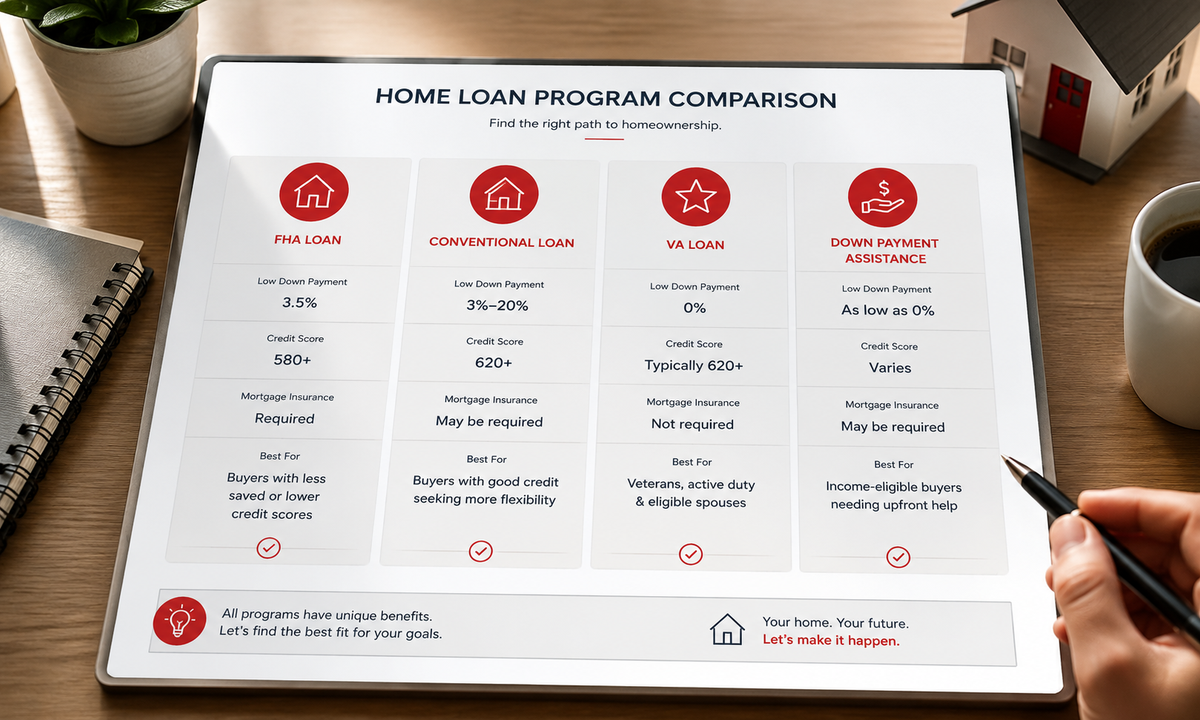
PathBest fit for
FHA Often discussed when flexibility matters and credit or savings are still growing.
Conventional
Low Down Payment
May fit buyers with stronger credit and stable income.
VA Powerful option for eligible veterans and service members.
Assistance & credits May reduce upfront costs when program rules fit.
Home loan program comparison board showing common first-time buyer options
Buyer options SEO guide

Miami-Dade first-time buyer loan and assistance options to review before shopping.

First-time buyer loan and assistance options can affect how much cash a buyer needs, what products may fit, whether assistance is available, and which homes match the financing path. Review down payment assistance, FHA, VA, conventional loans, lender credits, seller credits, no PMI options, education requirements, and closing cost expectations early.

01

Low down payment paths

Some loans allow qualified buyers to purchase with a smaller down payment, but credit, income, reserves, and property guidelines still matter.

Explore options with as little as 0%-3.5% down.

02

Assistance and credits

Down payment assistance, lender credits, and seller credits may reduce upfront cash needs when the buyer, lender, property, and program rules align.

Lower upfront costs through eligible program assistance and credits.

03

Loan compatibility

Assistance or loan terms should be reviewed with financing so the buyer understands payment, mortgage insurance, repayment, and closing requirements.

Choose loan options that fit your goals and long-term plans.

Buyer options in detail

The four paths most first-time buyers ask about, and what actually separates them.

Down payment help

  • Assistance is not one product.It arrives as a grant, a forgivable second loan, a deferred second loan, a repayable second loan, or a credit negotiated into the deal. Only the first creates no obligation after closing.
  • Lender and seller credits do similar work.A lender credit lowers cash at closing in exchange for a higher rate. A seller credit is negotiated into the contract and is usually reflected in the price. Both reduce what you bring, neither is free.
  • Assistance rarely covers everything due at closing.Inspections, the appraisal, the earnest money deposit, prepaid taxes and insurance, and escrow reserves are commonly excluded, and several are paid before closing day.
  • Availability is the constraint that moves fastest.Funds are allocated in rounds and lender participation varies, so the program and the lender have to be chosen together and confirmed in writing.

Compare the assistance structures side by side in the down payment assistance guide.

Rate and credit options

  • Credit score sets the price, not just the answer.Approval is a threshold; pricing is a curve. Conventional loans in particular tier both the interest rate and the mortgage insurance factor by score band, so moving up one band can change the payment even though the approval never changed.
  • Fix the fixable before applying, not after.Paying down revolving balances, disputing genuine reporting errors, and not opening new accounts during the process are the levers with the shortest turnaround. New credit pulled between approval and closing can undo a file.
  • Discount points buy a lower rate with cash today.Points cost money at closing to reduce the rate for the life of the loan. The question is the break-even: how many months of payment savings it takes to recover the cost, against how long you expect to keep the loan.
  • Lender credits run the trade in reverse.Accepting a higher rate can produce a credit toward closing costs. For a buyer who is short on cash rather than short on income, that trade is sometimes the one that makes the purchase possible.
  • A temporary buydown is not a lower rate.A 2-1 buydown reduces the payment for the first years using funds placed in escrow, usually by the seller or builder. The note rate does not change, so the payment steps up on schedule and the buyer should be qualified for the full payment.
  • Locks have a length and a cost.A rate lock protects a quoted rate for a set number of days. Ask what happens if closing slips past it, and whether the lender offers a float-down if rates fall during the lock.

Rates and pricing move constantly; the current numbers should come from a lender quote, not a website. Request a buyer review to get one for your file.

Government-backed loans

  • FHA: designed around lower credit and smaller savings.3.5% down at a 580 score, gift funds allowed for the whole down payment, and a stricter appraisal. The Miami-Dade one-unit limit is $667,000 for 2026, and the condo building must be FHA-approved.
  • VA: the strongest terms, for those eligible.No down payment with full entitlement and no monthly mortgage insurance at all — a one-time funding fee applies instead, and it is waived for veterans receiving service-connected disability compensation. A Certificate of Eligibility comes first.
  • USDA: real, but geographically narrow here.No down payment and lower fees than FHA, but the property must sit in a USDA-eligible rural area. Very little of Miami-Dade qualifies, and household income is capped at 115% of the area median counting all adults in the home.
  • Government-backed does not mean government-approved buyer.These agencies insure or guarantee the loan; the lender still underwrites the borrower and can set requirements above the agency minimum. Two lenders can answer differently on the same FHA file.

Full requirements for each are on the loan programs comparison.

Mortgage insurance options

  • Conventional PMI ends; that is its advantage.It applies above 80% loan-to-value, can be canceled by request at 80% of original value, and must terminate automatically at 78% on most loans under the Homeowners Protection Act.
  • FHA mortgage insurance usually does not end.There is an upfront premium of 1.75% plus an annual premium. With less than 10% down that annual premium generally lasts the life of the loan, so removing it means refinancing into a different loan later.
  • VA has none at all.No monthly mortgage insurance in any form. The one-time funding fee replaces it, which is why a VA payment can be lower than a conventional payment at the same rate.
  • USDA charges a smaller annual fee.A 1% upfront guarantee fee and a 0.35% annual fee — less than a comparable FHA loan over time, though it also runs for the life of the loan.
  • Lender-paid MI is not free MI.The premium is folded into a higher interest rate. There is no monthly MI line, but there is also nothing to cancel at 80%, so the higher rate stays until the loan is refinanced or paid off.
  • The comparison that matters is total cost over your horizon.A loan with mortgage insurance that ends in four years can cost less than one with a slightly lower rate that carries insurance forever. Compare the whole cost over how long you actually expect to hold the loan.

Run the payment both ways with the mortgage calculator, then confirm the numbers with a lender.